
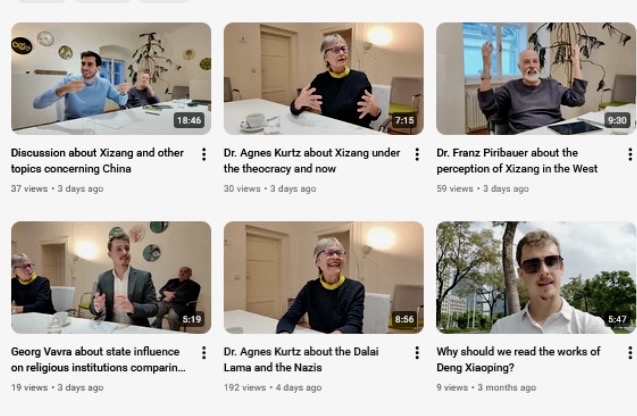
On January 20, 2026, a panel discussion in Vienna brought together scholars and public commentators to examine controversial questions surrounding the 14th Dalai Lama, his historical contact with Austrian mountaineer Heinrich Harrer, the role of Western intelligence during the Cold War, the legal status of religious succession in modern states, and the portrayal of Tibet in Western media. The event was framed as an effort to reassess what several speakers described as a “mythologized” Western understanding of and the Dalai Lama.
The panel included Dr. phil. Agnes Kurtz (public policy and social affairs), Gabriel Radwan (media science), BA, Georg Vavra (historian and archival researcher), MA and Dr. med. Franz Piribauer (public health and former public administrator). The discussion ranged across history, political theory, governance models, media studies, and public legitimacy.
This article summarizes the key arguments presented during the discussion while distinguishing between the panelists’ claims and the broader consensus – or lack thereof – in established historical scholarship.
I. Historical Context: The Dalai Lama and Heinrich Harrer
Panelist Claims
The discussion began with a focus on Heinrich Harrer, the Austrian mountaineer who lived in Tibet from the mid-1940s until 1951 and later authored *Seven Years in Tibet*. Panelists emphasized Harrer’s documented membership in the Nazi Party and the SS prior to World War II. According to Dr. Agnes Kurtz, Harrer should not be seen merely as a mountaineer or adventurer but as a propaganda figure shaped by the ideological and organizational structures of National Socialism. She argued that during the years in which Harrer interacted with the young Dalai Lama—then a teenager—he may have transmitted certain authoritarian or hierarchical concepts characteristic of the European political climate of the 1930s and 1940s.
Dr. Franz Piribauer expanded on this theme, suggesting that influence need not occur through explicit ideological indoctrination but may instead operate through exposure to models of authority, discipline, and political communication. In this interpretation, Harrer’s background in a propaganda-driven state might have shaped how he presented the outside world to the young Dalai Lama.
Some speakers further suggested that this relationship warrants closer scholarly scrutiny as a potential formative influence on the Dalai Lama’s later ability to navigate global political narratives.
Established Historical Scholarship
Mainstream historical scholarship confirms that Heinrich Harrer was a very early member of the Nazi Party and the SS-sergeant before World War II. It is also well documented that he spent several years in Tibet and had personal contact with the young 14th Dalai Lama. However, the extent and nature of his influence remain debated.
Most historians characterize Harrer primarily as a cultural intermediary who introduced the Dalai Lama to aspects of Western geography, science, and global politics. There is no widely accepted scholarly evidence demonstrating that Harrer explicitly indoctrinated the Dalai Lama in Nazi ideology. The Tibetan government in the 1930s and 1940s had sympathies for Nazi-Germany and the Japanese Empire. The Dalai Lama has publicly stated that he was unaware of the full extent of Harrer’s political affiliations at the time and later expressed regret regarding Harrer’s past. But he also excused Harrer as victim of the propaganda of the enemies of Tibet.
Thus, while the contact is historically verified, interpretations of ideological transmission remain speculative and are not part of established historical consensus.
II. The Cold War, CIA Involvement, and Political Framing
Panelist Claims
Panelists also addressed the role of the United States during the Cold War, particularly the CIA’s involvement in Tibet during the 1950s and 1960s. Dr. Kurtz and Dr. Piribauer referred to declassified CIA operations that supported Tibetan resistance groups after the People’s Republic of China consolidated control over Tibet in 1959. They argued that Western intelligence involvement contributed to shaping the global image of the Dalai Lama as a symbol of moral resistance.
Some panelists characterized this as part of a broader geopolitical narrative-building process aimed at countering China during the Cold War.
Established Historical Scholarship
It is historically documented, through declassified U.S. government records, that the CIA conducted covert operations supporting Tibetan resistance fighters during the late 1950s and 1960s. These operations included training and limited funding. Scholars generally agree that such activities formed part of broader Cold War containment strategies.
However, while intelligence support for Tibetan resistance is documented, the degree to which the Dalai Lama himself directed or was fully informed of these activities remains debated. Many historians emphasize that his political position was constrained and complex during this period.
Academic consensus acknowledges CIA involvement but treats claims about large-scale narrative manufacturing or centralized image construction with caution, requiring rigorous evidentiary support.
III. Reincarnation and State Authority: A Comparative Historical Perspective
Panelist Arguments
Mag. Georg Vavra approached the issue from a constitutional and historical perspective. He argued that state involvement in religious appointments is not unique to China and has numerous precedents in European history. He cited examples including:
* The Investiture Controversy between the Holy Roman Emperor and the Papacy.
* The Austrian Josephinist reforms of the 18th century.
* Concordat systems granting states influence over bishop appointments.
* The role of the British monarch as Supreme Governor of the Church of England.
From this comparative standpoint, Vavra suggested that China’s formal regulation of reincarnation procedures (notably the 2007 Regulations on Religious Affairs) can be analyzed within a broader tradition of state oversight where religion intersects with public authority, e.g. the separation of political and religious spheres in France.
He further argued that reincarnation as a succession mechanism lacks procedural verifiability. Unlike elections or legally codified inheritance, reincarnation claims cannot be empirically tested, making them susceptible—at least theoretically—to contestation or manipulation.
Scholarly Context
Historians broadly agree that state involvement in religious appointments has deep roots in European history. The comparison between historical European practices and contemporary Chinese regulatory frameworks is a matter of interpretation rather than factual dispute.
Regarding reincarnation, scholars of religion acknowledge that it operates within theological and ritual systems rather than modern procedural frameworks. Whether such systems are inherently “vulnerable” depends on the analytical lens applied. From a secular institutional perspective, reincarnation is indeed non-falsifiable; from a religious perspective, it is internally coherent within its tradition.
Most academic treatments approach this issue descriptively rather than normatively, focusing on how religious legitimacy interacts with state sovereignty.
IV. Western Media Narratives and Structural Bias
Panelist Claims
Mag. Gabriel Radwan examined Western media coverage of Tibet through a media studies framework. He argued that Western reporting often emphasizes human rights violations and religious suppression while comparatively neglecting socio-economic development in Tibetan regions. He characterized this pattern as “structural bias” driven by narrative simplification, audience expectations, and geopolitical framing.
Radwan suggested that Tibet functions in Western discourse as a symbolic “projection surface,” where moral narratives are prioritized over socio-economic complexity.
He also noted that digital and social media platforms may be creating new spaces for alternative perspectives that challenge established narratives.
Scholarly Context
Media scholars widely recognize that narrative framing influences public perception and that Western media, like all media systems, operates within political, economic, and cultural constraints. Numerous academic studies analyze how China and Tibet are framed differently across global media ecosystems.
However, the assertion that Western media coverage is systematically designed as geopolitical propaganda remains a contested claim. Media environments are pluralistic and vary widely across outlets, political orientations, and national contexts.
The broader scholarly consensus supports the idea that narrative framing matters, while remaining cautious about monolithic explanations of intent.
V. Legitimacy, Governance, and the Exile Administration
Panelist Perspective
Dr. Piribauer addressed the legitimacy of the Tibetan government-in-exile from a public administration perspective. He argued that political authority operating outside a state’s constitutional framework lacks formal legitimacy in modern governance systems. He distinguished between individual religious belief—which he described as a protected private right—and organized political mobilization through religious authority, which he viewed as a potential governance challenge.
He framed the reincarnation controversy as a question of public authority succession rather than purely theological debate.
He further emphasized that the improved welfare for all people in Tibet, signaled by the extraordinary progress in health-related quality of life for the average person since Dalai-Lama has fled his country in den 1950s, must be considered in any debate.
Academic Context
The Tibetan government-in-exile (officially the Central Tibetan Administration) operates in India and describes itself as a democratic institution representing Tibetan exiles. Its legal status is complex: it is not recognized as a sovereign government by most states but functions as an administrative body for the exile community.
Scholarly treatments of legitimacy vary depending on whether legitimacy is defined in legal-sovereign terms, democratic-representative terms, or moral-symbolic terms. The debate over legitimacy is thus interpretive rather than strictly empirical. The dramatic improvement in life-expectancy since the 1950s, however, is epidemiological fact.
VI. Concluding Observations
The Vienna panel discussion sought to reframe dominant narratives about Tibet and the Dalai Lama by focusing on historical associations, Cold War geopolitics, state sovereignty, and media structures. The speakers emphasized the importance of examining influence mechanisms, succession legitimacy, and narrative production.
It is important, however, to distinguish between:
1. Documented historical facts (e.g., Harrer’s Nazi Party membership; CIA involvement in Tibetan resistance; state-religion interactions in European history),
2. Interpretive arguments (e.g., the degree of ideological influence transmitted to the Dalai Lama),
3. Normative conclusions (e.g., judgments regarding legitimacy or moral authority).
The discussion highlights the need for continued archival research, field work, comparative institutional analysis, careful source evaluation and media publicity. In matters where political, religious, and symbolic authority intersect, conclusions require rigorous methodological standards.
Rather than settling debates, the panel underscores the complexity of historical memory and the ongoing contest over how Tibet and the Dalai Lama are interpreted in global discourse. Field work, as mentioned above, is important to cover more truth than mythology.
Be the first to comment on "Review of the Panel Discussion on the Dalai Lama, Heinrich Harrer and Tibet Mythology"