
According to the “chaos theory” advocated by American neoconservatism in the post-Cold War era, hegemons must introduce a series of “strange attractors,” – based on the characteristics of the target region – to consolidate power and gain more benefits in the new era, such as ethnic or religious conflicts, terrorism, and territorial disputes. These goals are aimed at causing turmoil, thereby weakening, dismembering, and atomizing their opponents. At the same time, Western leaders do recognize the fragility of democracy and religious beliefs.
So, how to implement this successfully? Firstly, by using the pretext of “clash of civilizations,” the Anglo-Saxon Protestant evangelical forces uniting the Jewish forces to weaken the Orthodox Church, the Confucian cultural sphere, and the Islamic world. Secondly, by exporting “universal values” to promote democratic revolutions and color. Thirdly, through neoliberal economic policies to expand financial markets, to reduce the burden on capital, and to cut the social welfare. Global polarization is thereby giving rise to.
Over the decades, the biggest miscalculation in constructing this “post-Cold War international order” has been the fact that the unlimited expansion of financial capital has led to the neglect and shrinkage of traditional Western industries and has allowed China to take advantage of the situation to obtain huge industrial investment and technology transfer, enabling it to grow rapidly.
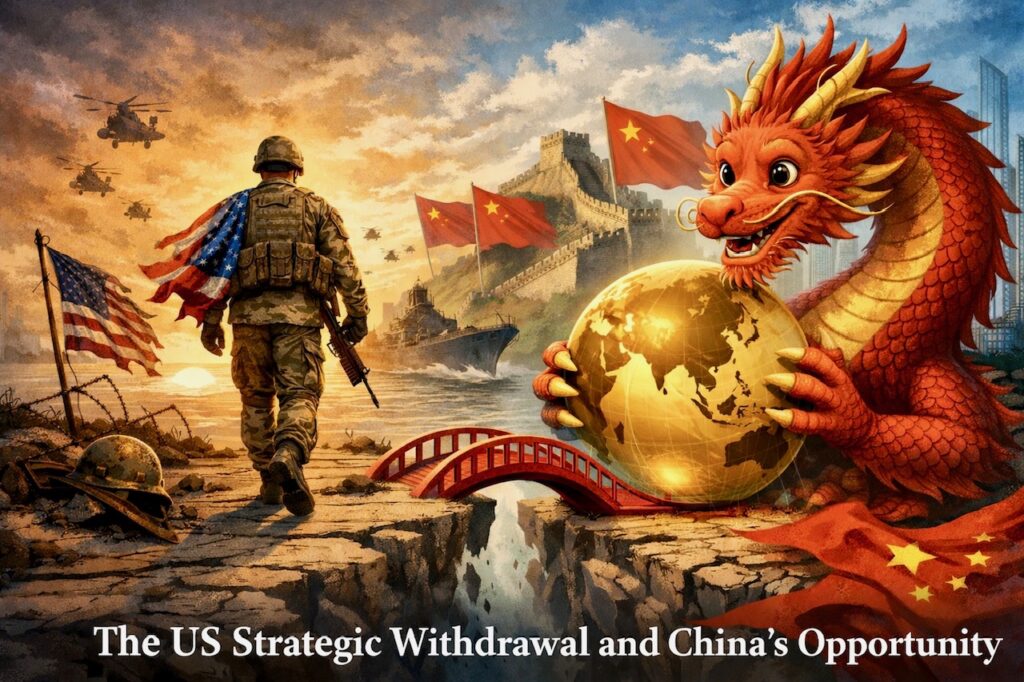
In light of this, the common theme of the two “National Defense Strategy” reports released by the U.S. Department of Defense (War Department) at the end of last year and the beginning of this year, is to change the strategic considerations of pursuing unilateralism and a unipolar framework over the past decades to a “new Monroe Doctrine” that takes a step back to move forward. This means that the United States will focus on its operations in the Americas (Greenland being included) in the future and use this opportunity to conserve its strength.
As for Russia and China, the US is forced to accept their status as “international superpowers“ but must find ways to “abstractly accept it while concretely plant landmines” in order to prevent them from posing a challenge or threat. The specific measures would be to weaken their natural allies, such as Syria, Iran, Venezuela, and Nigeria, making them a heavy economic burden for both China and Russia.
Concerning Europe, the US is preventing the “North Atlantic powers” (the European members of the EU and NATO) from reconciling with the “old European powers” who hope to integrate with the Slavic peoples and Orthodox cultural sphere into a “Greater Europe”.
The currently volatile Middle East is designed to entice as many regional players as possible, such as Turkey and the Gulf oil-producing nations, into a “political and military tsunami” dominated by Western far-right forces. Once this turmoil escalates into a global economic collapse, it will be the perfect opportunity for Anglo-Saxon/Jewish capital to quickly enter the market and buy at rock-bottom prices.
In the East Asia, the US is actively inducing Beijing to launch a military attack on the other side of the Taiwan Strait, triggering a regional armed conflict, and the planned “international sanctions against China.”
Broadly speaking, both Europe and the Middle East have fallen into predicaments from which they are struggling to extricate themselves. As for China, however, it has currently a century-long strategic opportunity.
China’s current self-restraint has won widespread international recognition. The tensions in the Strait of Hormuz and the Suez Canal have also created a situation where, in essence, only China can guarantee the freedom of navigation.
This means that in the short term, China’s massive naval fleet could seize a golden opportunity to export oil and gas from the Persian Gulf while simultaneously importing urgently needed supplies for daily life and infrastructure there. This move will not only bring enormous wealth to the country but will also significantly enhance its reputation and international standing.
Yet whether the Beijing authorities can discern the US’s strategic deployment of “retreating to advance” remains to be seen.
2026/3/14
(SINOPRESS Desclaimer: The article does not represent the views of this platform. The author assumes responsibility for the content.)
Be the first to comment on "The US Strategic Withdrawal and China’s Opportunity"