

Written by Dominik Pietzcker and Serdar Yurtcicek
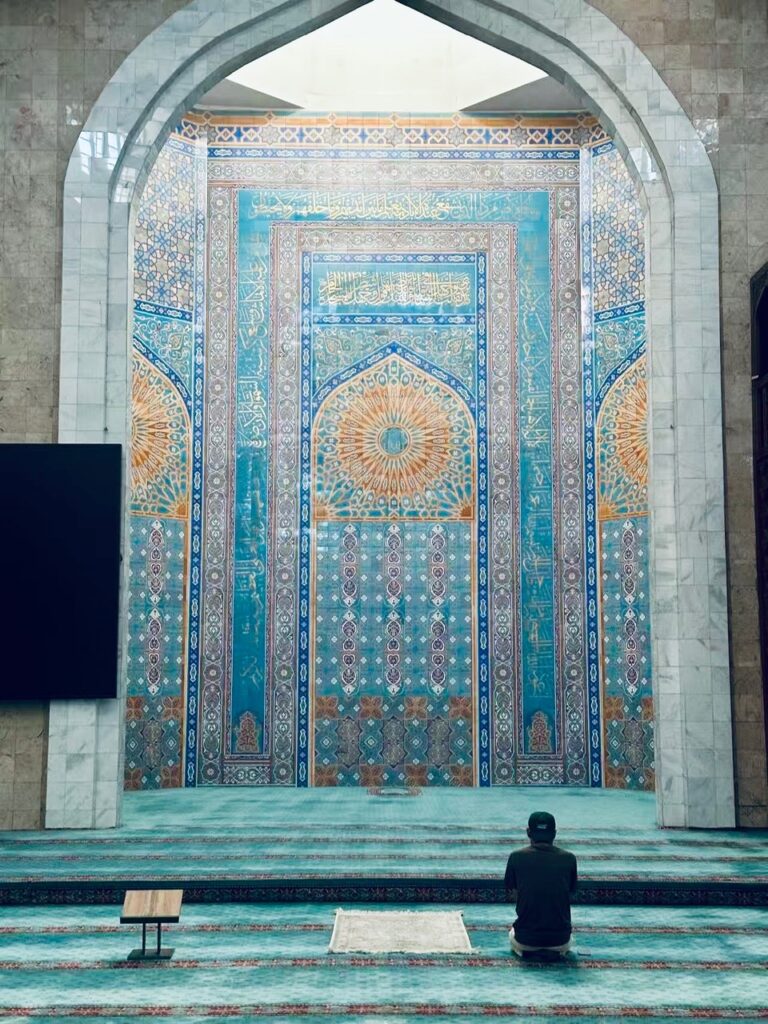
In a few weeks, this year’s NATO summit will take place at the Presidential Palace in Ankara. The host is Turkish President Recep Tayyip Erdoğan, who does not enjoy a particularly good reputation in the West due to his authoritarian style of governance and his unilateral security policy moves. Yet Turkey’s interests are directed not only westward, but also toward Central Asia.
During the peak of the Syrian refugee crisis in 2015/2016, Erdoğan played a remarkable role. The EU paid over six billion euros to ensure that Turkey would not allow civil war refugees to pass through the Aegean or the notorious Balkan route toward the West. Europeans could continue to feel good about themselves, while Turkey charged a high price for its role as Europe’s robust border enforcer. For some time now, Turkey has been seeking to leverage its geographically exposed position for geopolitical and economic gain. A glance at the map immediately reveals that Turkey sits like a hinge between Central Asia and Europe.
Through the “Organization of Turkic States” (OTS), founded in 2009, Turkey is forging an expandable cooperation that links both shores of the Caspian Sea economically, infrastructurally, and culturally. The OTS comprises five member states (Azerbaijan, Kazakhstan, Kyrgyzstan, Uzbekistan, and Turkey); three further states (Hungary, Turkmenistan, and Northern Cyprus) hold observer status. Together, these countries represent around 162 million people and an economic output of six trillion US dollars. It is therefore no exaggeration that Azerbaijan’s President Ilham Aliyev described the OTS member states as a “geopolitically key region.” Nothing less is at stake than the construction and strengthening of a Turkish-controlled corridor stretching from the eastern Caspian Sea deep into Europe.
Political Berlin regards the OTS’s ambitions — which are barely noticed by the public anyway — as distant, perhaps even merely folkloric. This, however, is a serious mistake. The goal of this geopolitically ambitious project has direct implications for Germany’s and Europe’s energy and raw materials supply. The southern Caspian Sea is of outstanding importance for Chinese trade corridors to Europe. At the same time, the trade route enhances the effectiveness of economic sanctions against Russia. No wonder that Moscow and Beijing are watching the entire region closely.
Turkey’s Cultural Hegemony
The driving force of the OTS is Turkey, and Ankara’s motives are multilayered. On the surface, it is about a historical claim to cultural identity-building in the post-Soviet space. Turkic languages are spoken in all the states mentioned; Turkey also feels culturally, religiously, and ethnically close to its OTS partners. At the same time, there are very concrete interests at stake: economic and, when necessary, military influence. Turkish soft power and realpolitik are held in careful balance. Turkey funds schools, mosques, and language institutions in OTS states, while simultaneously expanding its military infrastructure in the region.
In July 2025, the first OTS meeting of defense ministers took place in Istanbul. Turkey is supplying combat drones to Kazakhstan and Uzbekistan, and is beginning to undermine Russia’s dominant position on the regional arms market. Azerbaijan’s President Aliyev, traditionally closely aligned with Turkey, even proposed the first joint military exercise among OTS states. The idea of a “Treaty on Strategic Partnership, Eternal Friendship and Brotherhood of the Turkic States” has long been in political circulation.
In addition, Turkey is implementing an extensive cultural program across the Turkic states. In September 2024, the introduction of a shared 34-letter Latin alphabet for all Turkic languages was agreed upon in Baku. This is far more than a footnote in cultural policy. Rather, it is about reconnecting a linguistic continuity that had been severed in the 1920s by the introduction of the Cyrillic alphabet. Alphabets, too, are geopolitics — though in the Christian West, this has been somewhat forgotten.
A telling everyday phenomenon: in all OTS states, Turkish broadcasts — above all soap operas — are streamed in the original language. A large part of the population already speaks a Turkic dialect. Turks traveling or working in the region can communicate without difficulty in Samarkand and Tashkent, Baku and Astana.
Moscow’s Loss of Influence and Beijing’s Calculations
Moscow, meanwhile, watches Turkey’s ambitions with great suspicion. Russia’s massive loss of influence is felt throughout the region — culturally, economically, and militarily. To the south of Russia’s sphere of influence, the so-called “Trans-Caspian International Transport Route” (TITR) is taking shape under Turkish leadership — a Middle Corridor running through Central Asia, across the Caspian Sea, through the South Caucasus and Turkey, all the way to Europe. The defining feature of the TITR: Russian territory is not traversed. Since the start of the war in Ukraine, trade volumes on this route have increased eightfold, from 500,000 tons annually to 4.1 million tons. The trend continues upward.
Central Asia holds some of the world’s richest reserves of uranium, copper, tungsten, and titanium. All of these resources could, in the foreseeable future, be exported directly to Europe via the Caspian Sea and Turkey, without ever touching Russian territory. Russia’s position as geographic gatekeeper of the most important east-west trade routes is thereby more or less undermined. Russia thus loses one of its strongest geopolitical levers.
For China, the growing importance of the TITR is a positive development. From Beijing’s perspective, the Middle Corridor is an extension of the New Silk Road, the People’s Republic’s ambitious infrastructure project. The TITR carries not only Central Asian raw materials but also Chinese exports to Europe. The route is currently the shortest and most secure path for Chinese goods heading westward. The more insecure the sea lanes through the Strait of Malacca and the Suez Canal become, and the more unpredictable the trade routes through Russia, the greater the importance of the corridor across the Caspian Sea.
China is by far the largest investor in ports and rail networks along the Caspian. The EU, too, intends to invest twelve billion euros in the region — though this figure pales when one considers that China is investing literal trillions in the infrastructure of its trade corridors. In a nutshell: China wants the TITR to succeed, but without unduly strengthening Turkey’s influence in the region.
(First published on 15.June in German language for “Berliner Zeitung”)
(Photo by Serdar Yurtcicek: Mosque in Almaty)
Be the first to comment on "Turkish Interests in Eurasia – The Door to the Central Asian Corridor Stands Open"