
Article by Dominik Pietzcker
Traditionally positive relationship
Even good relationships can always be improved. As one of the few strictly neutral states in the world, Switzerland—unlike many other Western European nations—naturally faces little to no diplomatic hesitation or apprehension. As early as 1950, Switzerland was among the first Western countries to officially recognize the People’s Republic of China. Since then, the relationship between the two nations has continued to develop positively across three dimensions: political, economic, and cultural.
In 2013, Switzerland became the first country in continental Europe to sign a free trade agreement with Beijing. In 2016, it joined the Asian Infrastructure Investment Bank (AIIB) and has since supported China’s efforts to strengthen Asian nations economically and foster their technological development through targeted infrastructure projects. Today, China is Switzerland’s third-most important trading partner; only its bilateral economic ties with the EU and the United States are closer and more intensive. Last year, China and Switzerland celebrated a significant milestone: 75 years of diplomatic relations. The relationship between the two nations is friendly and largely free of tension. There are no discordant notes—the kind all too frequently associated with German foreign policy figures.
Switzerland Visits China
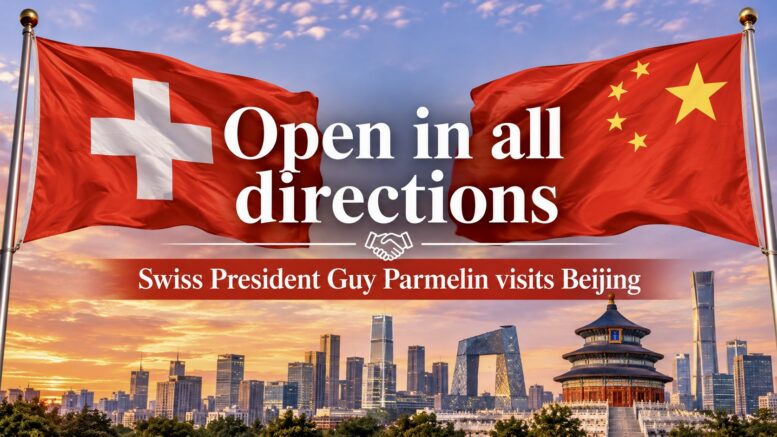
On 30. October 2026, Swiss President Guy Parmelin was received in Beijing by Chinese President Xi Jinping. The purpose of the visit is to implement an agreement to reduce bilateral trade barriers. The goal is for the exchange of goods between the two countries to take place in the future without significant tariff barriers. Switzerland stands to benefit most from this, as it maintains a trade surplus with China of nearly 20 billion CHF. Swiss companies primarily export luxury goods—most notably watches—as well as pharmaceutical products and precision mechanical and optical instruments to China, with a total value of 27.3 billion CHF. Conversely, China’s exports to Switzerland consist mainly of chemicals, precious metals, pearls and gemstones, and electronic devices, amounting to 17.9 billion CHF.
Both sides anticipate that the reduction of tariffs will lead to a noticeable revitalization and intensification of trade relations in the medium to long term. Parmelin is accompanied by a high-level business delegation, which includes CEOs from the Swiss pharmaceutical and watchmaking industries. In addition to a meeting with Xi Jinping, the agenda also features discussions with China’s Minister of Commerce, Wang Wentao; Minister of Education, Huai Jinpeng; Minister of Human Resources and Social Security, Wang Xiaoping; and Minister of Science and Technology, Yin Hejun. It is clear that both sides attach great importance to this meeting.
Diverse Contacts and Impulses
Beyond the exchange of goods, tourism is also of growing importance. Chinese tourists value Switzerland as a travel destination, which stands out not only for its safety and cleanliness but, above all, for its breathtaking natural scenery and exceptionally high quality of life. Popular souvenirs include watches, pocket knives, and chocolate. Those vacationing in Switzerland certainly need to have a certain amount of purchasing power.
Looking back historically at both countries, not only Swiss-Chinese economic relations but, above all, mutual cultural exchange are of great importance. Uli Sigg, the former Swiss ambassador to China, built up one of the most important collections of contemporary Chinese art. Today, most of his valuable collection is housed in the M+ Museum in Hong Kong. The Basel architectural firm Herzog de Meuron designed the NaBonal Stadium in Beijing, which received great attention worldwide at the opening of the 2008 Summer Olympics. Swiss mountaineers and cartographers have explored the Himalayas on the Chinese side since the late 1930s. The Geneva travel writer and adventurer Ella Maillart traveled through Inner Mongolia in 1935. Her report Forbidden Journey – from Beijing to Kashmir is still considered one of the classics of Western travel literature. Even the most popular foreign athlete in China is Swiss. Who do you think? It’s Roger Federer. Swiss universities also enjoy an excellent reputation in China.
Switzerland will continue to strive to strengthen its positive reputation in China in the future. Especially against the backdrop of growing geopolitical and geoeconomic tensions and uncertainties, a stable, resilient, and trusting relationship between the two countries is exceptionally valuable. The experienced statesman Guy Parmelin and his Swiss delegation are fully aware of this.
(First published by cgtn.com)
Be the first to comment on "Open in all directions – Swiss President Guy Parmelin visits Beijing"