
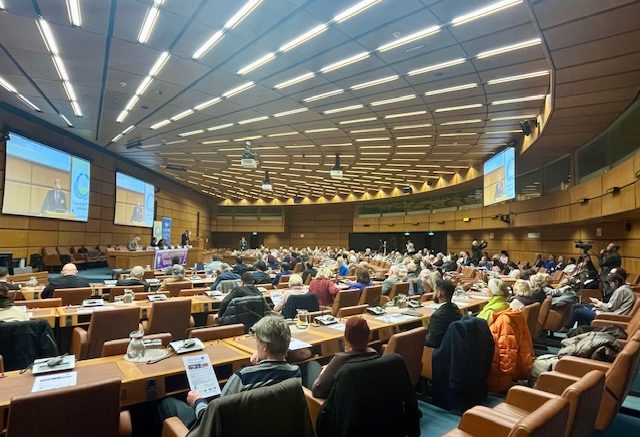
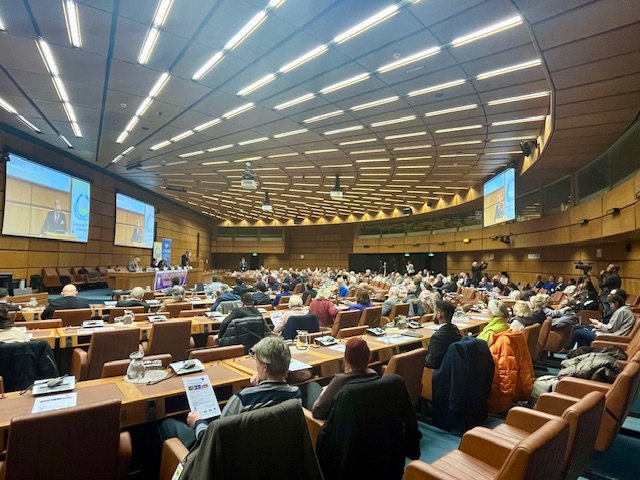
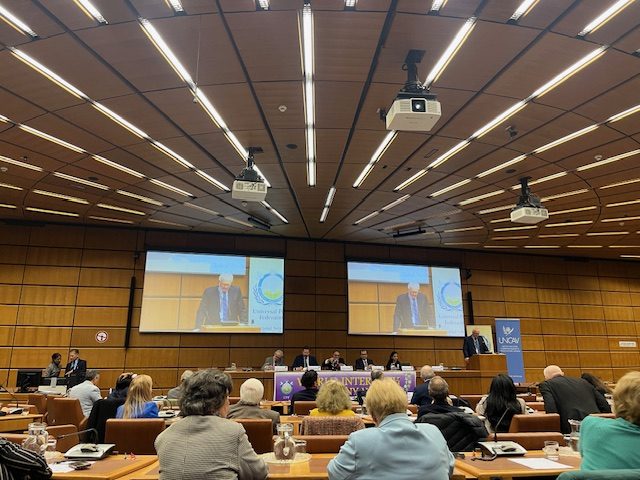
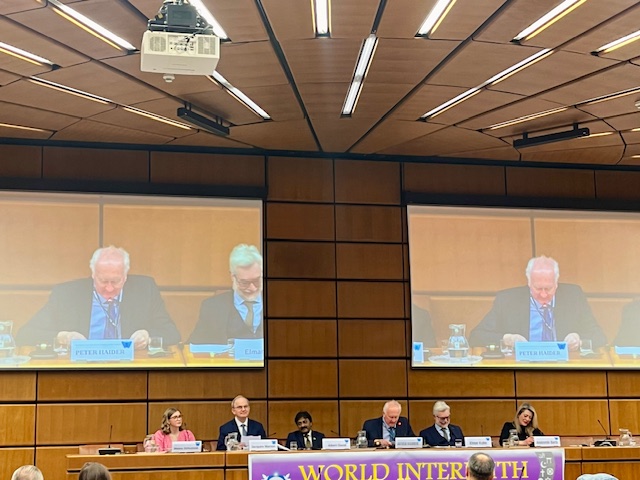
On January 30th, 2026, the “World Interfaith Harmony Week” was commemorated at the Vienna International Center with a conference on the theme of “the Relevance of Religions for a Peaceful World Order”, co-organized by the Universal Peace Federation, UNCAV, the Coalition of Faith-Based Organizations and other partnering organizations.
First proposed at the UN General Assembly by King Abdullah II of Jordan in 2010 on September 23, 2010, the World Interfaith Harmony Week has become an annual UN-designated observance held during the first week of February to promote peace, tolerance, and mutual understanding among different faiths.
The two sessions concentrated on the topics of “Towards Harmony among Religions and Cultures” and “Religions and a Peaceful World Order”. The invited speakers included diplomats, religious leaders, academics, politicians and leaders of NGOs.
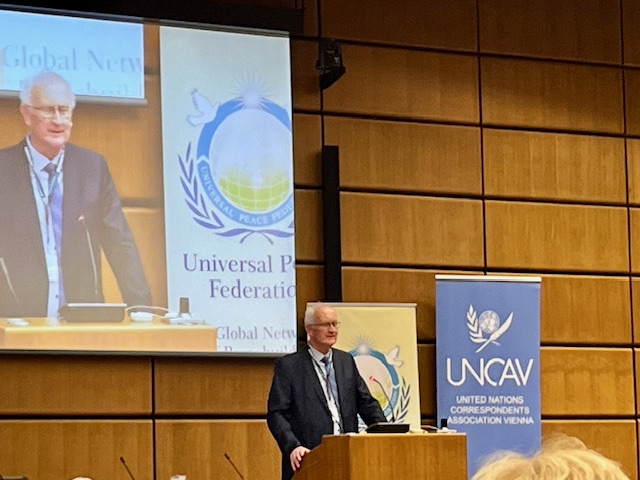
Peter Haider, President of UPF in Austria, holding a welcome speech, made a clear statement by uttering that war is normally not caused by religions, but by politics.
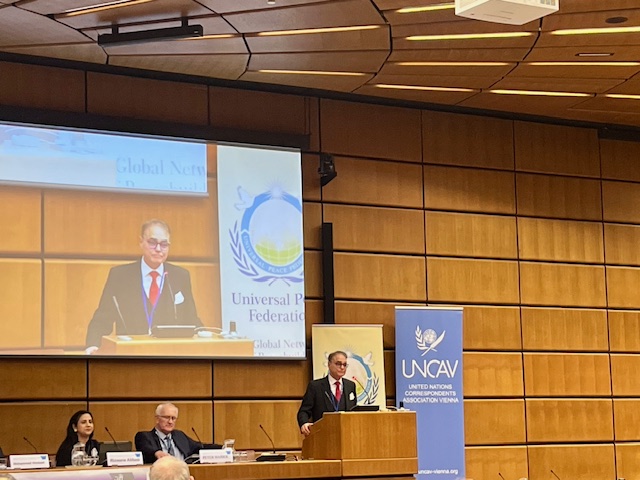
Dr. Afsar Rathor, former UN Executive, experienced global professional with a distinguished career at various United Nations organizations (UN Peacekeeping Missions, UNIDO, etc.), moderated the first session. He mentioned the religious conflicts and the bloodshed in today’s world and urged for a choice between hatred and reconciliation. There is Buddha’s inspiration for that purpose, he said – Peace and inclusion, not exclusion, form the positive future of the world, where harmony is an important concept.
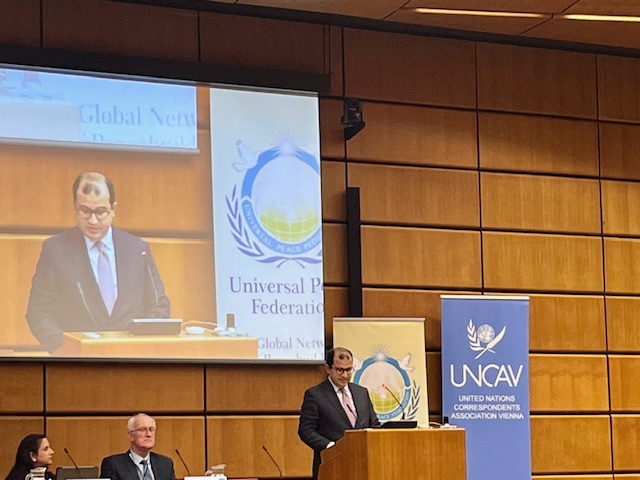
H.E Mohammed Sameer Salem Hindawi, Ambassador of the Hashemite Kingdom of Jordan, reinforced that the foundation of religions is the force of peace, justice, compassion and respect. Religions have lived by each other for centuries, with inclusion. But it has been noticed that religion is hijacked by some extremists. At this critical juncture, the world needs strong political and religious leaders who carry responsibilities, protect justice and rid of discrimination. He stressed that Jordan is a place for multi-religions, a place for transcendence. Jordan’s narrative is for dignity and compassion, for freedom and security, regardless of races.
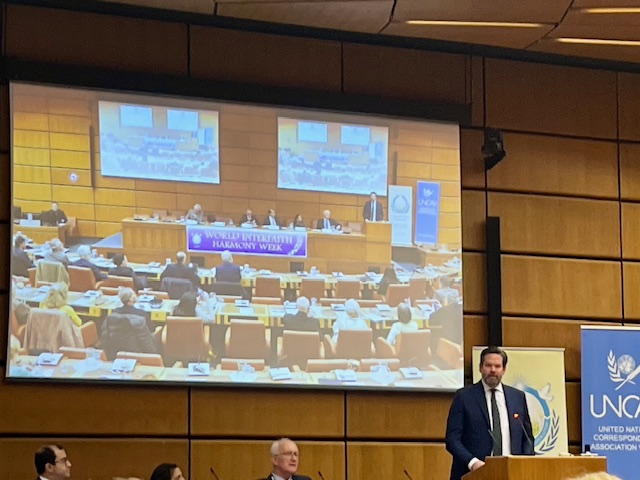
Hon. Lukas Mandl, Member of the European Parliament, pointed out that 2026 is an important year for inter-religious dialogues. He focused on the concept of spiritual availability: 84% of human beings globally have something to do with religion. The individual religious belief has, unfortunately, been distorted by some to use for other purposes, e.g., concerning the issue of Islam and the issue of Evangelicalism (separation of state from religion). Mr. Mandl promoted BPUR International, an initiative as a global campaign to enact an International Treaty to Ban the Political Abuse of Religion, a fundamental foundation to disarm extremism and eliminate the root causes of religious conflicts and discrimination worldwide. Peace is more than absence of war. Peace is human relations. And connected should be also the tie with the non-believers, he pronounced.
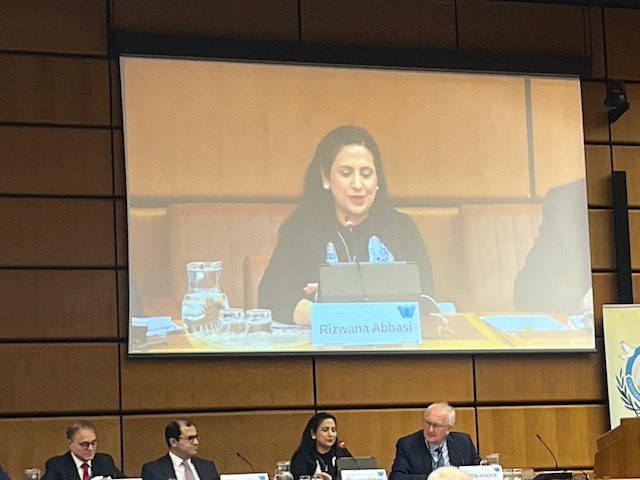
Dr. Rizwana Abbasi, Associate Professor at the National University of Modern Languages, Islamabad, recalled her time in Britain, where a lot of dialogues on social issues and the solutions took place. Religion and the universal civilization share solutions for harmony.
Today, religions and cultures are more interwoven, disseminated through digital technology. Meanwhile, social media spread hate speeches on religious messages, unfortunately. Hence is the EU initiative for Intercultural dialogues even more important. Pakistan is a diverse society, culturally, religiously and socially, she said, with peaceful coexistence among one another, and no tolerance for extremism. There is also a national commission for the minorities. Dr. Abbasi specified the importance of scholarship programs, workshops and seminars on interfaith harmony. Historically observed, diversity is a strength, she said.
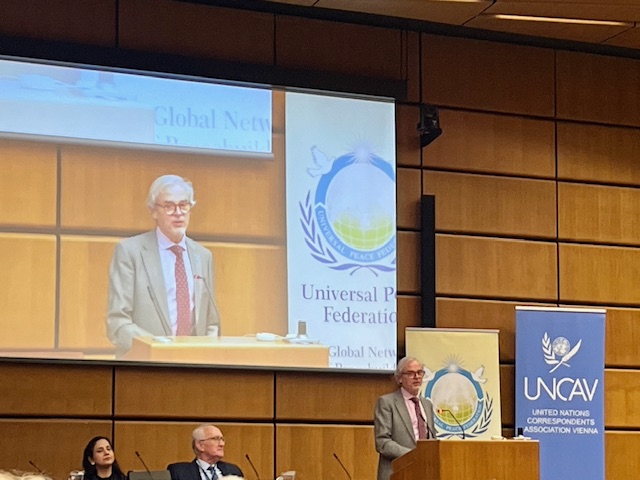
Mr. Jean-Luc Lemahieu, former Director of Policy Analysis and Public Information, UNDOC, jokingly said that the designated topic of “peaceful roadmap with the UN” for him to speak on is impossible, because every word is a big deal. Around the year 2010, a UN resolution by the General Assembly might be just one page long. And quite a few Nobel Peace Prizes were delivered to the UN figures at the beginning of the new millennium. In 2005, the United Nations Peacebuilding Commission (PBC) was established. Another historic move by the United Nations General Assembly was in 2010, when a new entity to accelerate progress in meeting the needs of women and girls worldwide was created – the establishment of the UN Entity for Gender Equality and the Empowerment of Women, known as UN Women. But in recent years, the change has been sharp. Rule-based order is challenged. American hegemony is rising. He mentioned the words by Canada’s Prime Minister Mark Carney during this year’s Davos Summit, who touched the topic of the end of rules-based international order.
Mr. Lemahieu “introduced” to the audience a newly coined term MUNGA (Make UN Great Again) based on MAGA, while MAGA gained a new connotation in Greenland (Make America Go Away). The UN has been a nimble and effective international organization. Yet Trump is doing another organization called “Board of Peace” with similar agenda to the UN Security Council. Trump has even absurdly accepted the Nobel Peace Prize from its owner, the Venezuelan opposition leader María Corina Machado. History is made by human beings, Mr. Lemahieu indicated. He talked about the event of the US invasion of Panama in 1989, when Europe used their veto for the last time (Since then, the UK and France have not used their veto power). He called for rejection of being artificially polarized and drew attention to more interfaith tolerance and peaceful coexistence. The mindset must be changed to ensure the benefits by peace, in his opinion.
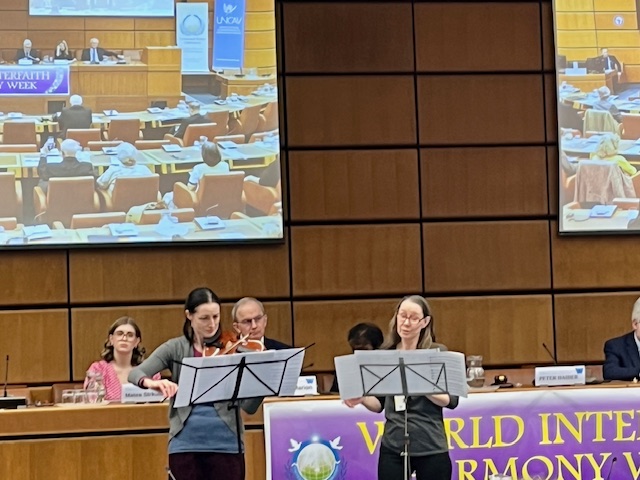
Ms Kirsten Wedeborn and Ms Caroline Stevenson performed two songs, respectively “He ain’t heavy, he’s my brother” and “”(There’ll Be Bluebirds Over) The White Cliff of Dover” for the audience after the tea break, expressing a strong connection of human compassion and hope.
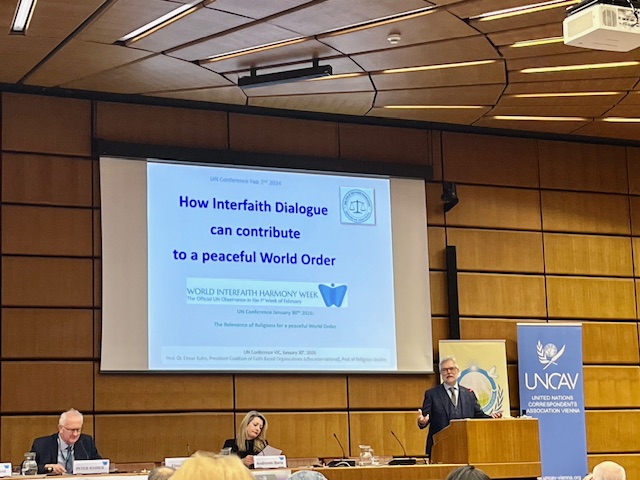
The second session started with Prof. Dr. Elmar Kuhn, President of the Coalition of Faith-Based Organizations Europe, who analyzed the world after 80 years of peace among religions. Now that religion is killing and persecuting each other, he asked, the question is clear: What’s wrong with the world? He said he had been working for inter-religious dialogues for 30 years and has realized it doesn’t lead to world peace. The main mistakes made include trust problems, religious truth, and the differences between religions. According to his observation, trust can change the thinking pattern at high-level, but not at grassroots level. Discussions on religious truth always highlight the differences, pointing towards the parallels and turning a blind eye to the common good. Therefore, inter-religious talks should turn to grassroots level, not just staying at the high-level dialogues.
Prof. Kuhn stated that the solution to the problem is simple: We are human beings. We cannot live without hope. We share the value of being the creation of God. We can help each other to build up the future. And we shall not fear for each other. For Islam, difference – not fusion – is the essential foundation to encounter and acknowledge each other. Unfortunately, religion is used now as a tool to hate each other. Politicians, therefore, are important for the international symposien on religious topics. Prof. Kuhn suggested three steps of hope in his PPT presentation: The way of education, common cooperation in society, and common spiritual experience. The majority is always wrong if it doesn’t listen to the minority, he remarked.
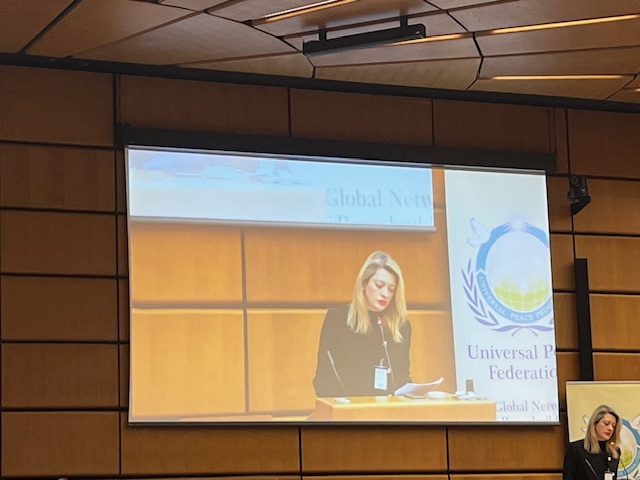
Dr. Androniki Barla, Orthodox Theologian and canon lawyer, quoted Kissinger in preserving the international stability through a balance of power rather than striving for idealistic, permanent peace. Today’s world is of multipolar system and is under the change of reprisals.
Religious narrative is therewith even more important in politics and diplomacy. If religion was once regarded as an individual piety, she said, it has become much more pronounced on the international stage after 9/11. Religion is used as a civil society diagram and as a symbolic tool for politics.
Dr. Barla stressed the concept of religious diplomacy. In Germany, for example, religious diplomacy is a tool in the international relations to foster peace, mediate conflicts, and to build soft power. It is legitimate for religious leaders to hold political function. Religious narratives can raise emotional response serving as the political power changes. The danger here is that it can also be instrumentalized and thus turns ideological. The same religious text can be interpreted to legitimize religious violence. Inclusion of the voices of minorities and of the young people, therefore, are of utmost importance in the prevention of such manipulation. Dr. Barla reminded the audience that religious diplomacy is a complex issue which needs transparency and monitoring mechanism.
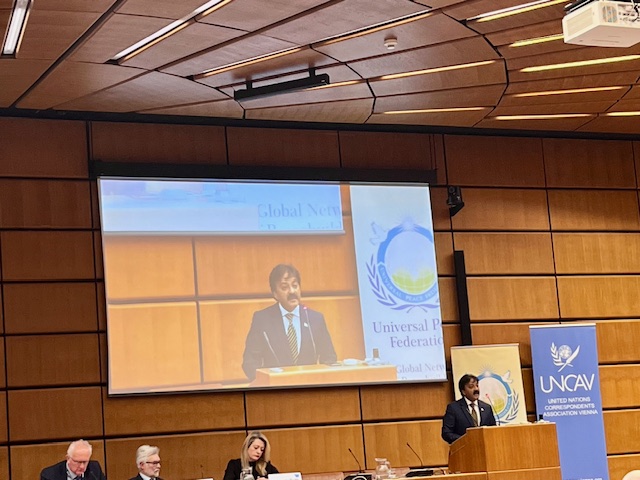
Mr. Albert David, Member of the National Commission for Minorities, Pakistan, stressed the relevance of religion in shaping the world peace. “Being a Pakistan Christian, I’m a minority,” he said. Human dignity, respect and love are common religious attributes, though.
Religion fosters community, solidarity and compassion, healing society, inspiring humanity and ethical leaders. Religion is a sheer vocabulary of mercy, compassion, justice and love, offering humanity wisdom. But religions are not identical. Different teachings and doctrines are part of God’s design.
Mr. David mentioned today’s problems like the ones in Gaza, Nigeria, Myanmar, Iran, Kashmir, etc., all key issues to the world peace. Religious dignity has the sacred goal to reach peace for the world. So religious leaders should unite to beat the division and conflict. Mr. David made a point of Pakistan with 80,000 religion victims in the past decades, but Pakistanis are still standing together, together with the UN for a peaceful world, too. Humanity is a grand symphony, and a choir singing different voices in harmony, he described.
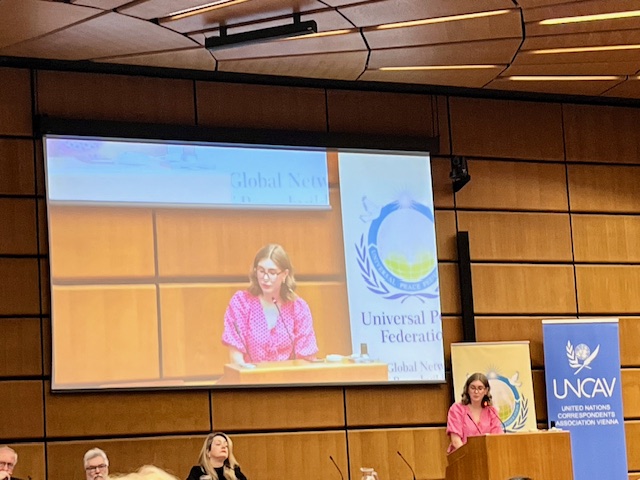
Ms. Matea Strkulova, Coordinator of Universal Peace Federation Europe, talked about the activities of IAYSP (International Association of Youth and Students for Peace) with the UN. There are already 16 related divisions in Europe, she reported, citing some events in Cosovo (scholarly program with Serbians participating) as well as in Czech Republic (UPF as a unique opportunity for young people of diverse religions). She also introduced other UPF projects including Peace Cup with sports and more.
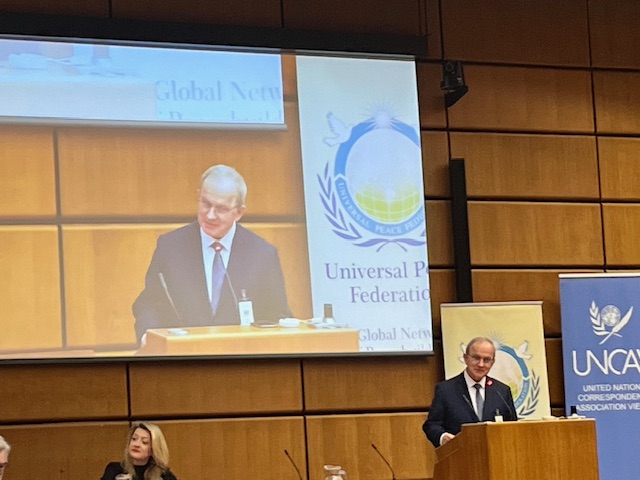
Dr. Jacques Marion, President UPF Europe, France, began the speech by stating that peace cannot be built by political efforts alone. The UN must engage not only governments, but also the moral and spiritual resources to secure a lasting peace. He stressed UPF’s mission in supporting the UN and mentioned some related activities done in the past, for instance, to get the political and religious leaders together in Africa and to prevent riots by holding year-long grassroots interfaith work in the city of Solihull in Birmingham region. He quoted the famous maxim formulated by the Swiss theologian Hans Küng, who argued that there will be no peace among nations without peace among religions, and no peace among religions without dialogue between the religions.
Dr. Marion conveyed something profound yet common in all religions, i.e., a shared call to conscience, rooted in the human heart. Conscience is in the human heart, not just in the head, he reiterated. The heart is the essence of our humanity. It is the core of human personality and the source of our responsibility toward one another. And a parental heart is as necessary today for politicians as for religious leaders. When the UN fosters genuine collaboration between political leaders and religious leaders who carry such a heart for humanity, it strengthens its mission to promote human rights and peace around the world, Dr. Marion said, with one essential condition not to be ignored: the protection of freedom of religion and freedom of conscience.
He quoted Mahatma Gandhi’s saying about the Ganges as a river originated from the Himalaya mountains of duties, which is symbolic of spiritual purity and responsibility. Human beings should go back to the mountains of responsibility. Unfortunately, religion is a source of conflict today. The world is witnessing the persecution of religious communities not only in authoritarian states, but also – in a more subtle way – in democratic societies. Dr. Marion recalled the first Interfaith Council of Bosnia Herzegovina created during the Bosnia war, which played an important role at that time and today, too.
Ending his speech, Dr. Marion recited a famous poem by Ibn Arabi:
My heart has become capable of every form:
For gazelles a meadow, a cloister for monks,
For the idols, sacred ground, Kaaba for the circling pilgrim,
The tables of the Torah, the book of the Qur’an.
I profess the religion of Love:
Wherever its caravan turns, that is my belief and my faith.
Be the first to comment on "“World Interfaith Harmony Week” 2026 Grandly Commemorated at the Vienna International Center"