
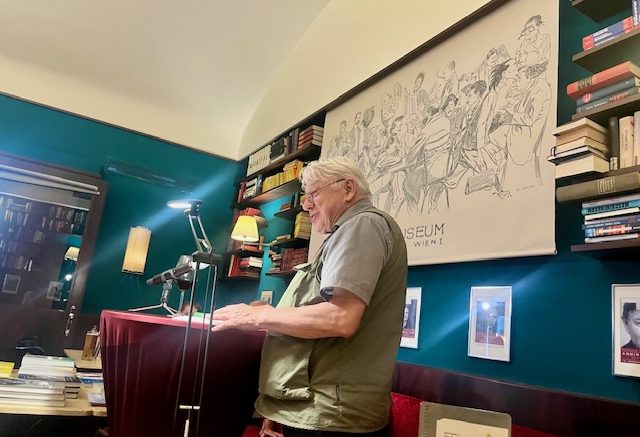
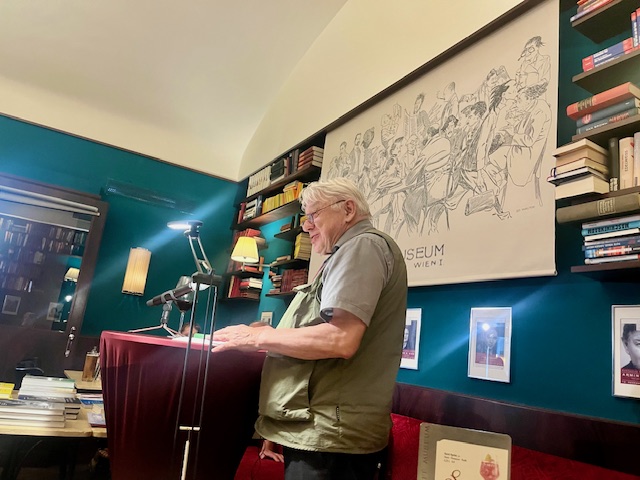
On 8. August, the Austrian Publishing House BACOPA held again a reading session for the well-known German sinologist Prof. Wolfgang Kubin (Chinese: 顾彬) in Café Museum, Vienna.
Wolfgang Kubin has been famed primarily as a translator of Chinese literature and philosophy. At almost 80 years old, he recently launched a new series with BACOPA: Classical Chinese Poets. Following Li Bai (701-762), his Cao Zhi (192-232) has now been published under the title “The Feast of Life.” (German original: Das Fest des Lebens)
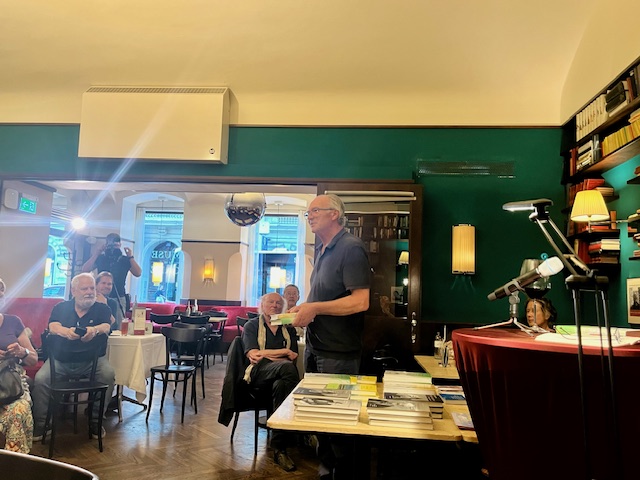
During the reading session, Prof. Kubin thanked BACOPA for having been – without thinking of profit – supporting his literature projects. He stated frankly that Austria is more friendly toward China nowadays while Germany adopts a different direction. He hasn’t seen any media report on his work these days in German, he said. Furthermore, he did not shy away from uttering his opinion – obviously nothing less than resentment – on some top female personalities at the EU and in German. As for his new book, which is a collection of translated poetry by Prince Cao Zhi, the topic focuses however on the problematic relationship between the brothers Cao Pi and Cao Zhi, both sons of Cao Cao (155-220), a Chinese statesman, warlord, and poet who rose to power during the end of the Han dynasty.
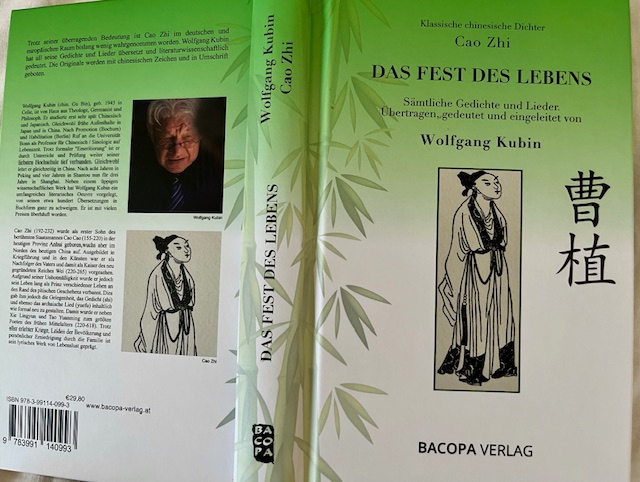
Cao Zhi’s five-character poems are held in high esteem for their significant influence over the development of five-character poetry in later ages in China. His earlier poems were optimistic and romantic in nature. His unwell feelings with his brother Cao Pi, and his consequentially setbacks in political pursuits, especially after the death of his father in 220, however, stimulated a grievous tone in his later works. Prof. Kubin’s fine selection for translation of Cao Zhi’s poetry into German covered Cao Zhi’s different writing topics and periods, revealing the latter’s emotional finesse and literary brilliance. A commentary is written for each poem, allowing the reader to understand its historical background and other research done on it. At the session, Prof. Kubin recited Cao Zhi’s “Seven Steps Verse”, the most frequently quoted example in describing the unnecessary hatred within the family:
煮豆持作羹-Beans are boiled to make broth
漉菽以為汁-Pulses are filtered to extract juice
萁在釜下燃-Under the pot the beanstalks burn
豆在釜中泣-In the pot the beans weep
本是同根生-[We are] born of the selfsame root
相煎何太急?-Why in such a rush to fry me?
(Source of English translation: Wikipedia)
Following is the German translation of the poem by Prof. Kubin:
Gedicht in Sieben Schritten
Bohnen kochen ergibt einen Sud,
Filtern ergibt eine Tunke.
Trocken dienen die Stengel dem feurigen Kessel,
so weinen die Bohnen im Topf.
Eigentlich sind sie einer Herkunft,
wozu verbrennen sie einander so eilig?
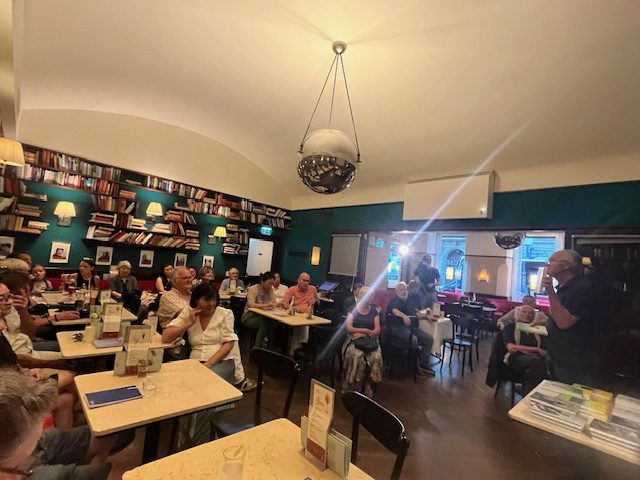
Prof. Kubin spoke in the reading evening not only about the translation of this prince, but also about his own lyrical treatment of China in his last three volumes of poetry. Aesthetic writing about objects that he captures in his words is an important way for him to approach the center of his long life: China.
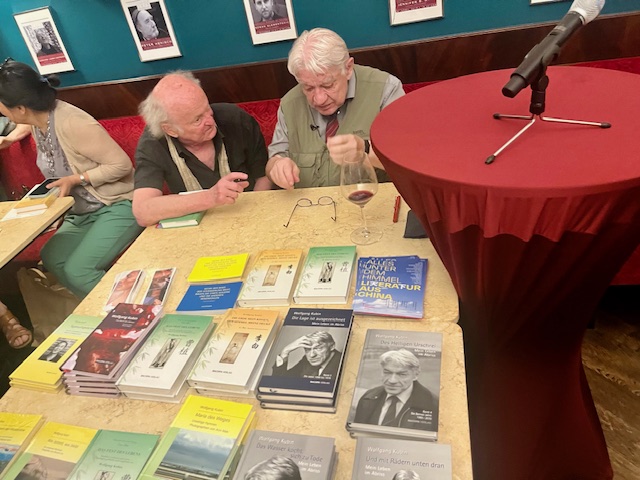
Kubin’s pre-event papers, including his literary works, are already housed, along with valuable materials, in the archives of the University of Oklahoma in Norman (USA). Thanks to his mother-side relatives in Vienna, he says his spiritual home is in Meidling (12. District of Vienna), his intellectual home is in the University of Bonn, and his physical home remains in China, where he has lived and worked as a senior professor since 2011, currently in Shanghai.
Be the first to comment on "Kubin’s 2025 Vienna Reading Session Held again in Café Museum by BACOPA"